 Skip to content

Last Updated 25th November 2025. Stepping on a nail at work may seem like a minor accident. However, this type of accident can cause severe injuries, including tetanus and bone infections. Furthermore, this type of accident can typically be avoided if your employer adheres to relevant health and safety legislation. If they have failed to do so, you may be entitled to accident at work compensation.
A successful accident at work claim can compensate you for your physical pain and mental suffering as well as any subsequent expenses, such as recovering costs for medical treatment, mobility aids and any loss of earnings experienced.
In order to claim this compensation, you will need to have compelling supporting evidence that proves your employer was liable for your injury. This can include copies of your medical records and the report in the accident at work book. Furthermore, your claim will need to be filed within the correct limitation period.
If this seems confusing, having legal support during the claims process can make it simpler for you. A specialist accident at work solicitor, like the ones on our panel, will have years of experience helping claimants such as yourself. They know what evidence to submit and know how to navigate the legal system.
To find out if you have a strong claim for stepping on a nail at work, speak to one of our advisors. Not only will they assess your claim, but they’ll also estimate how much compensation you could seek and advise you on what steps you can take. Additionally, if you qualify and wish to continue with Legal Helpline’s services, you can be connected to a solicitor from our panel.
Select A Section
- Can I Claim For Stepping On a Nail At Work?
- What Is The Accident At Work Claim Time Limit?
- How Could I Step On A Nail At Work?
- Types Of Foot Injuries Caused By Nails
- What To Do After Standing On A Nail
- How Much Could You Receive After Stepping On A Nail At Work?
- Get In Touch To Claim After Stepping On A Nail At Work
- Frequently Asked Questions About Stepping On A Nail At Work
- Learn More About Protecting Your Feet At Work
Can I Claim For Stepping On a Nail At Work?
All employers owe their employees a duty of care to take reasonable steps to prevent the risk of injury while at work. This duty of care is set out under the Health and Safety at Work etc. Act 1974.
Reasonable steps your employer could be implementing include:
- Performing regular risk assessments.
- Ensure the workplace is free of clutter and any hazards that can be removed.
- Providing you with appropriate personal protective (PPE), such as safety boots.
If you stepped on a nail at work and injured yourself, you may be eligible to make a personal injury claim. For your case to be valid, you will need to prove the following:
- A duty of care was owed by your employer.
- They breached their duty of care.
- This caused you to suffer your injury.
To discuss your potential accident at work claim today and receive free advice, you can contact our team of advisors. They can also help answer questions you may have about the claiming process.

What Is The Accident At Work Claim Time Limit?
If you stood on a nail at work and are thinking about seeking compensation, it’s important to note that a time limit applies to personal injury claims.
The Limitation Act 1980 sets out this limit. Typically, you get three years from the accident date to get your claim started. Once you start the case, you don’t have to worry about any legal limitation period.
In some cases, the claimant’s situation may allow them to have an exemption from the normal three-year limit. For example:
- Someone who stepped on a nail when they were under 18 years old can’t claim. They can once they turn 18, at which point they get three years, but a pause is in place before then.
- If a person doesn’t have the mental capacity to take legal action, then the time limit, is also paused. The three-year countdown only starts if they recover capacity, and this recovery date is considered the starting point of the three year period.
In either of the above cases, a trusted adult known as a litigation friend could end the pause by taking up the claim for the claimant.
If you stood on a rusty nail at work and want to check whether you’re able to claim, don’t delay. Call today, and you’ll get a quick and effective case assessment from our team of advisors.
How Could I Step On A Nail At Work?
There are a number of ways that you could be injured by employer negligence, which may entitle you to make a claim. For example:
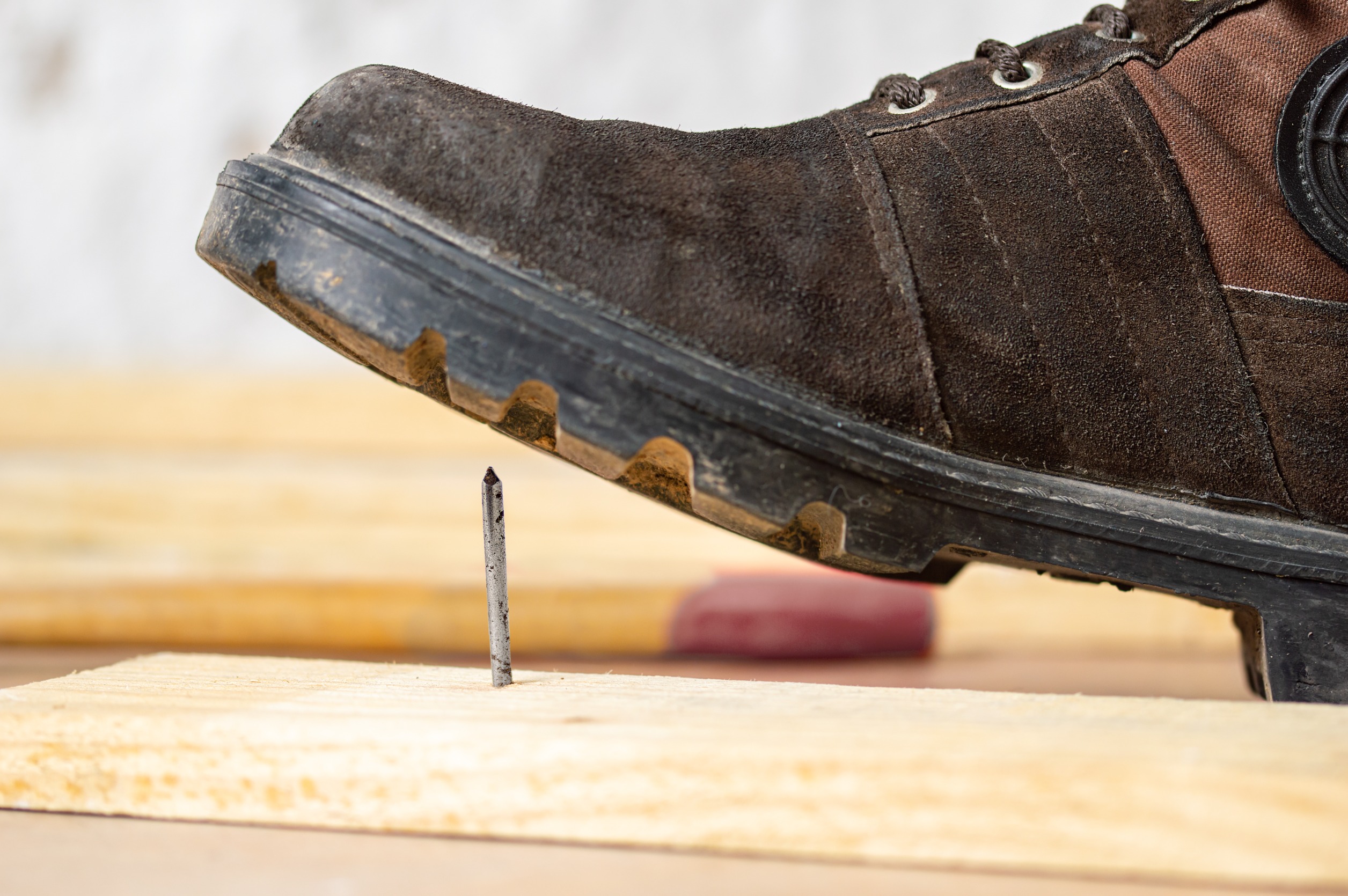
- Your employer might not have provided you with the necessary puncture-proof footwear when working in a warehouse. Consequently, you suffer an injury after stepping on a nail at work.
- An employee without the proper training may be tasked with using a nail gun to complete a task in the office. As a result, nails are left on the floor and you step on one, leading to you enduring a laceration.
- You are walking down a stairwell with no lighting in a factory. Because of this, you step on a nail that you cannot see. This causes you to fall down the stairs and sustain a foot injury as well as a head injury and elbow injury in the ensuing factory accident.
If you have been injured at work due to employer negligence, you might be able to claim. Speak with our advisors for more details.
Types Of Foot Injuries Caused By Nails
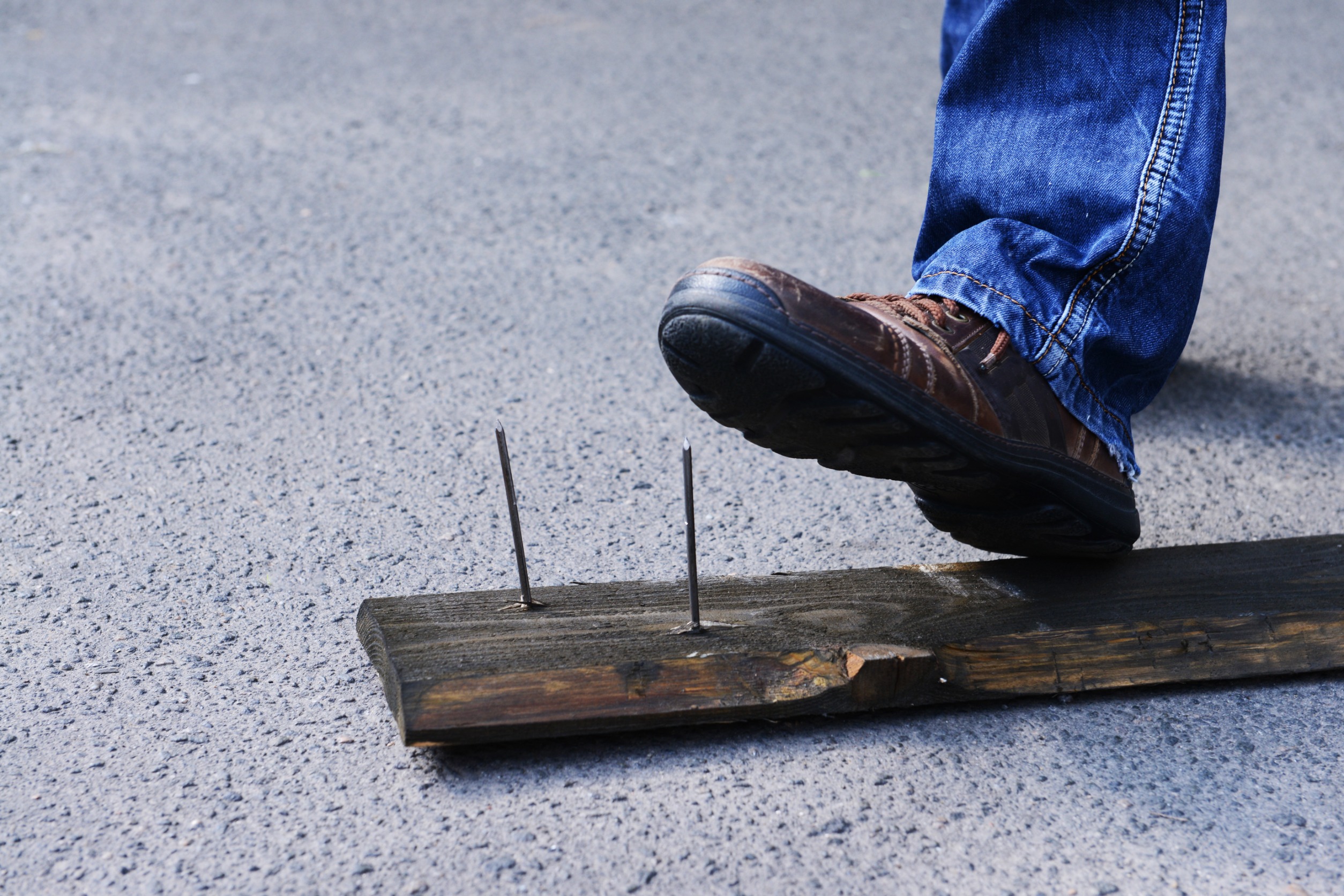
Stepping on a nail at work could lead to multiple injuries. For instance:
- A puncture wound. The width and depth of this could depend on the size of the nail.
- Torn skin or lacerations
- An infection in the injured area. For example, if the nail is dirty or the wound is left untreated, this could lead to issues such as sepsis, cellulitis, and osteomyelitis
- Tetanus
The severity of these injuries can vary with each case which is why it may be important to seek compensation. For example, if the nail is dirty or the wound is left untreated, this could lead to issues such as sepsis, cellulitis, and osteomyelitis.
Furthermore, a puncture wound from standing on a sharp object could damage the nerves, ligaments or tendons of the foot. This could inhibit mobility while the injury heals. In some cases, it could cause permanent repercussions.
Please do not hesitate to get in touch with an advisor from our team for more information in terms of how stepping on a nail could impact you.
What To Do After Standing On A Nail
If you suffer a puncture wound after stepping on a nail at work, you could be eligible to make a personal injury claim. However, any compensation claim needs to have supporting evidence.
Any action you took to treat puncture wounds following the incident could have generated useful evidence. For example, following puncture wounds and a foot injury, you may have:
- Decided to seek prompt medical care. For example, after stepping on a rusty nail, you may require a tetanus vaccination or tetanus booster. If you sought medical attention for your puncture wounds, your visit to a GP or hospital for medical help would have created a note in your medical records about the incident. A copy of these can be submitted when claiming compensation.
- Filled in the accident book. Any workplace that employs ten or more members of staff is required to have an accident log book. This should be filled out with your personal details, the time and date and any details relating to your accident. A copy of the accident log book can be submitted in support of a personal injury claim.
- Taken photographs. You may have taken pictures of the rusty nails that caused your injury or of the injury itself while it healed. Any photographs you took relating to your accident at work can be used to support a claim for compensation.
- Noted witness contact information. If anyone saw the incident that caused your nail puncture, you may have taken their contact details. Witnesses can provide a statement further into the claims process.
If you need any free advice about obtaining evidence, speak with a member of our advisory team.
How Much Could You Receive For Stepping On A Nail At Work?
If you are successful in your claim, the personal injury compensation you could be awarded may be split into two areas. All successful personal injury claims will include compensation for the pain and suffering caused by your injures; this is called general damages and accounts for both physical and mental injuries.
We have drafted a table of compensation figures that have been taken from the Judicial College Guidelines (JCG) which is a document of guideline brackets that lawyers use to help them value claims. We’ve also included the top entry, which isn’t from the JCG, but shows how compensation could be awarded in successful work claims. However, these amounts should only be used as guidance. This is because each accident at work claim is unique, and these figures are not guaranteed.
| Body Part | Severity | Compensation Bracket | Details |
|---|---|---|---|
| Multiple serious injuries and expenses | Very Serious | Up to £250,000+ | Settlements could include compensation for more than one severe injury plus any incurred expenses such as lost of wages and wheelchair purchase. |
| Foot | Amputation of one foot | £102,470 to £133,810 | Considered similarly to a below-knee amputation as the useful ankle joint is lost. |
| Foot | Very Severe | £102,470 to £133,810 | Injuries found in this bracket produce permanent severe pain or a really serious disability that is permanent. |
| Foot | Severe | £51,220 to £85,460 | These injuries cause continuing pain from traumatic arthritis or the risk of arthritis in the future. The treatment is prolonged and there's a risk of fusion surgery. |
| Foot | Serious | £30,500 to £47,840 | Involves continuing symptoms with the risk of osteoarthritis and future surgery. |
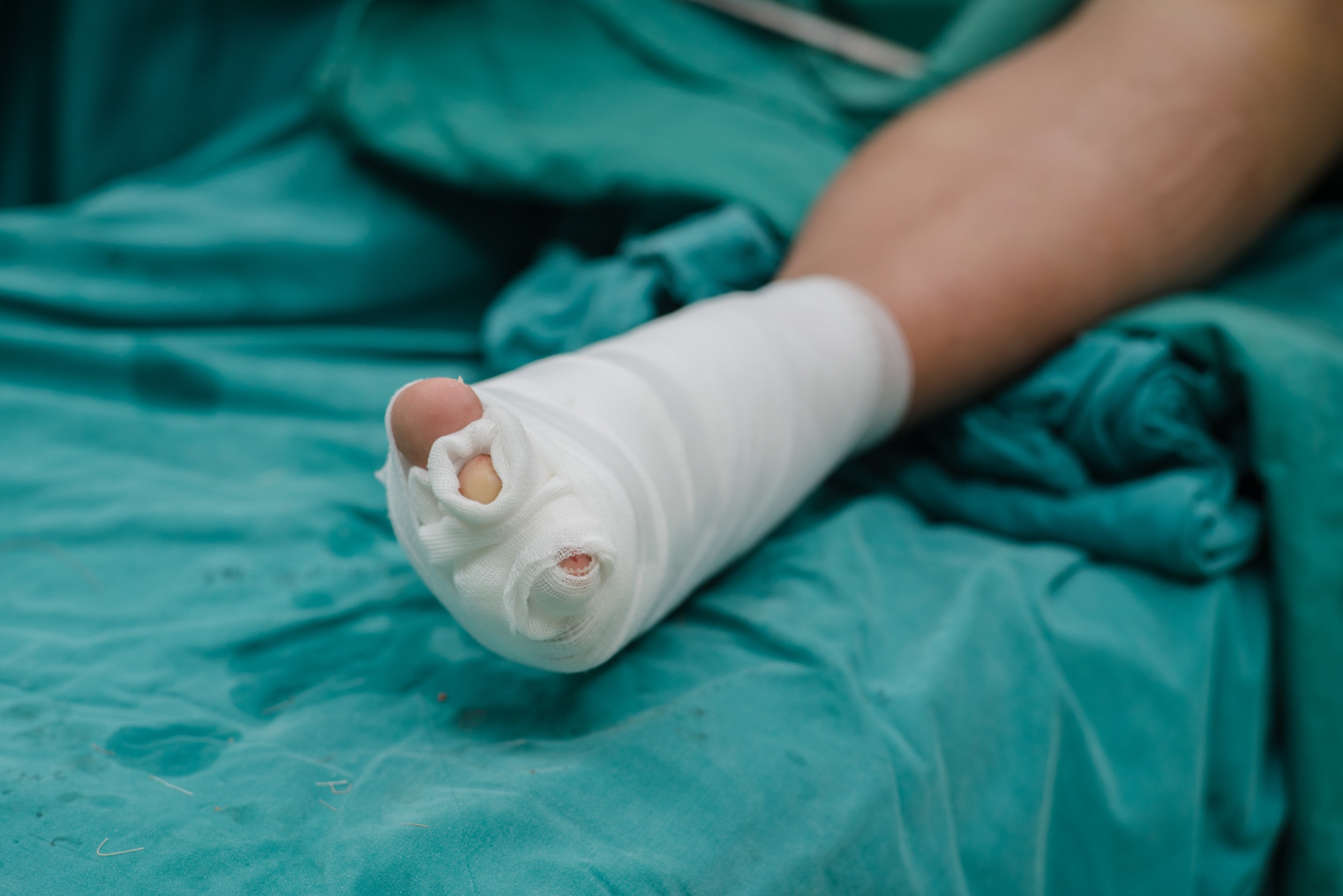
| Foot | Moderate | £16,770 to £30,500 | Puncture wounds and the like which cause permanent symptoms, such as pain aching or a limp. |
| Toe | Amputation | In the region of £38,210 | Amputation of the big toe. |
| Toe | Severe | £16,770 to £25,710 | Bursting wound injuries that lead to considerable permanent symptoms. |
| Toe | Serious | £11,720 to £16,770 | There will be some permanent disability by way of discomfort, pain, or sensitive scarring. |
Moreover, you might be awarded special damages for the monetary harm that you’ve incurred as a result of your injuries. For instance, you might be unable to drive until your foot recovers. Any travel costs, such as taxis, may be reimbursed through special damages.
It could also account for:
- Loss of earnings
- Home adaptations
- Care costs
- Medical expenses
Please speak with an advisor if you would like a more personalised insight into how much compensation you may be awarded in a successful claim. If your case is valid, you could be connected with a lawyer from our panel.
Get In Touch To Claim After Stepping On A Nail At Work
A personal injury solicitor from our panel can use their vast experience to cover all bases of your claim after stepping on a nail at work. This could help make the process run more smoothly than if you worked on your claim alone.
Claimants may find it beneficial to seek representation with a No Win No Fee agreement in place. The solicitors on our panel offer their services under a Conditional Fee Agreement (CFA).
If you are represented on this basis, there are generally no fees to be paid to your lawyer upfront or while your claim is ongoing. Moreover, if your claim is lost, you typically won’t have to pay any fees for the services your solicitor provides.
However, in the event of a successful claim, you will have to pay a legally capped success fee to your solicitor. This will be deducted from the payout you receive.
An advisor from our team is available to provide you with free legal advice 24 hours a day, 7 days a week. They may also connect you with an accident at work solicitor from our panel. To get in touch:
- Call us on 0333 000 0729
- Fill out our contact us form
- Use the live chat feature at the bottom of your screen

Frequently Asked Questions About Stepping On A Nail At Work
Here are some answers to the most frequently asked questions about stepping on a nail at work.
Do I Need To See A Doctor After Stepping On A Nail At Work?
Yes, it is highly advised that you see a doctor after stepping on a nail at work. Seeking medical attention will ensure that you get the care that you need, such as a tetanus injection, and create medical records that can support a personal injury claim.
Can I Get An Infection From Stepping On A Nail, And Does That Affect My Claim?
Yes, you can get an infection from stepping on a nail. The level of pain and suffering you experienced caused by an infection will affect your claim and what award you could get.
Who Is Responsible If I Stepped On A Nail At Work?
Generally, your employer is responsible if you stepped on a nail at work, as they must take reasonable steps to ensure your safety. This includes providing appropriate personal protective equipment and enacting housekeeping policies.
Can I Claim If I Stepped On A Nail On A Construction Site?
Yes, you can typically claim if you stepped on a nail on a construction site. The same duty of care is owed by your employer regardless of the workspace.
Do I Need To Take Time Off Work To Claim?
No, you do not need to take time off work to claim compensation.
Learn More About Protecting Your Feet At Work
Here are some more of our guides that can be useful when considering making an accident at work claim:
- Why is it important to report accidents in the workplace?
- I was stuck in a lift. Could I claim compensation?
- This guide can help you understand how to claim compensation due to the lack of work safety boots.
Furthermore, we have included additional reading that may be useful for you:
- NHS – Cuts and grazes guidance.
- GOV – Statutory Sick Pay (SSP).
- Health and Safety Executive – Report a health and safety issue.
Thank you for reading this guide on how to claim if you have been injured after stepping on a nail at work.