 Skip to content

If you slipped on a wet floor with no sign because the person or organisation responsible for the premises failed to take reasonable steps to keep you safe, you may be entitled to make a personal injury claim.Whether your accident happened in a public place or at work, you could potentially claim compensation if a wet or slippery surface was left untreated or without an adequate warning. A solicitor from our panel can assess what happened, explain whether you have grounds to bring a claim and identify the evidence that may help support your case.
A slip, trip and fall accident can affect far more than the immediate pain of your injuries. You may be recovering from a soft tissue injury. In other cases, the accident may have caused broken bones or a back injury. As a result, you may have lost earnings because you were unable to work. Medical expenses can also create financial pressure, while the accident may disrupt your everyday life. It can also be difficult to know whether you have grounds to claim, particularly if responsibility was never clearly established or you were left unsure whether the accident could have been prevented.
If you slipped on a wet floor with no sign and responsibility for the accident is unclear, understanding your legal position can feel just as difficult as recovering from your injuries. A solicitor from our panel will take the time to understand how the accident happened and explain whether the available evidence is likely to support your claim. From your first conversation, you’ll receive clear, practical guidance tailored to your circumstances, helping you understand your options and decide whether pursuing compensation is the right step for you.
Jump To A Section
- Does The Absence Of A Wet Floor Sign Prove Negligence?
- When Should Wet Floor Warning Signs Be Displayed?
- What Injuries Can Wet Floor Accidents Cause?
- How Legal Helpline Can Support Your Wet Floor Injury Claim
- Can I Claim On A No Win No Fee Basis?
- More Information
Does The Absence Of A Wet Floor Sign Prove Negligence?
No, the absence of a wet floor sign does not automatically prove negligence, but it can be important evidence when deciding whether a personal injury claim is likely to succeed. The person or organisation in control of the premises has a legal responsibility to protect people from foreseeable risks of injury. This is known as a duty of care. The key question is whether they breached their duty of care by allowing the wet floor to create an avoidable slipping hazard without providing an adequate warning.
For example, if a floor had recently been cleaned or a spillage had been reported, failing to display a wet floor sign or remove the hazard promptly may indicate that reasonable precautions were not taken. However, the presence of wet floor signs displayed does not automatically prevent a wet floor injury claim either. If the warning sign was poorly positioned or difficult to see, the organisation responsible may still be liable.
A solicitor from our panel can help determine whether the organisation should reasonably have recognised the hazard before the accident occurred. Determining whether a business breached its duty of care requires considering the wider circumstances of the accident rather than a warning sign alone.
Why A Warning Sign Does Not Automatically Prevent Liability
A warning sign does not automatically prevent liability because displaying a sign does not remove the slipping hazard. The person responsible for the premises may still need to deal with the wet floor itself.
For example, liability may still arise if a warning sign was positioned where visitors were unlikely to see it. The same may apply if the sign was placed too far from the wet floor. Liability could also arise if the spill was left unattended for an unreasonable period.
The courts will consider whether the precautions taken were reasonable rather than whether a sign was displayed in isolation.
As a result, a warning sign does not automatically prevent a business or organisation from being held responsible if the hazard was not managed properly or reasonable steps were not taken to reduce the risk of injury.
Proving The Wet Floor Created A Foreseeable Risk
A wet floor creates a foreseeable risk when a business or organisation should reasonably have anticipated that someone could slip and suffer an injury. This does not mean predicting the exact accident. Instead, the question is whether the hazard was obvious enough for reasonable steps to have been taken.
A recently reported spillage, a floor left wet after cleaning or previous wet floor slips in the same area may all indicate that the risk was foreseeable. A solicitor from our panel can assess evidence such as inspection records to determine whether the organisation should reasonably have recognised the hazard before the accident occurred.
Whether a wet floor created a foreseeable risk depends on the circumstances surrounding the accident and the available evidence. Contact our advisors today for free legal advice and to learn if you could claim after you slipped on a wet floor with no sign.
When Should Wet Floor Warning Signs Be Displayed?
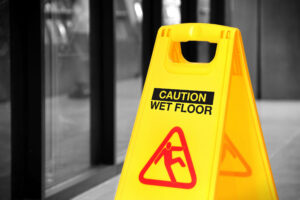
Wet floor warning signs should be displayed whenever a wet surface cannot be dried or made safe immediately and there is a foreseeable risk that someone could slip. They should alert visitors to a temporary hazard while appropriate steps are taken to remove the danger or prevent access to the affected area.
- A supermarket employee mops a shopping aisle after a bottle of juice spills. Until the floor is cleaned and dry, appropriate wet floor warning signs should be displayed to alert customers to the hazard.
- Rainwater is tracked into the entrance of a restaurant during bad weather. If staff cannot dry the floor immediately, warning signs should be placed where customers can clearly see them while the entrance is made safe.
- A refrigerated display cabinet leaks onto the floor of a supermarket. Until the leak is cleaned up or the area is safely isolated, appropriate warning signs should be displayed to reduce the risk of customers slipping.
Whether a warning sign should have been displayed depends on how the hazard arose. It may also depend on how long the danger remained and what was done in response. Additionally, the person or organisation should have appropriate inspection procedures and regular risk assessments in place to identify hazards before someone was injured.
Our panel can assess what happened and explain whether the measures taken were likely to meet the required standard of care and if you’d be eligible to claim if you slipped on a wet floor with no sign.
What Injuries Can Wet Floor Accidents Cause?
Wet floor accidents can cause a wide range of injuries, from visible, minor injuries such as cuts and bruises to severe injuries that have life-changing consequences. The type and severity of the injuries sustained will depend on factors such as how the fall happened and the surface involved. =
Common injuries caused by falls on wet floors include:
- Soft tissue injuries can affect muscles and other connective tissue. These injuries may cause pain and restrict movement.
- Broken bones can happen when someone lands heavily or tries to break their fall.
- Back injuries may cause ongoing pain and problems with mobility.
- Head injuries can occur if the person strikes the floor or another object. In more serious cases, the fall may cause a brain injury.
- Spinal cord injuries can have lasting effects on movement. The most serious injuries may result in permanent disability.
- Hip injuries can be especially serious for older adults. Some people may need surgery followed by a lengthy period of rehabilitation.
- Arm injuries can result from landing heavily during a fall and may restrict the use of the affected arm.
Every wet floor accident is different, and some people may suffer multiple severe injuries that require ongoing treatment and rehabilitation. A solicitor from our panel can explain how the nature of your injuries may affect your legal options and the compensation you may be entitled to claim.

How Legal Helpline Can Support Your Wet Floor Injury Claim
Legal Helpline can support your wet floor injury claim by connecting you with a solicitor from our panel who will assess the circumstances of your accident and explain your legal options from the outset, guiding your case through the claims process on your behalf. If you slipped on a wet floor with no sign and are unsure whether you have grounds to claim, you’ll receive straightforward advice tailored to your circumstances. Our panel can also explain what evidence may help identify who was responsible.
If your enquiry is accepted, a solicitor from our panel will deal directly with the other party or their insurer on your behalf. They’ll keep you informed as your claim’s progress develops, answer any questions that arise and work to secure the compensation you may be entitled to claim. This allows you to focus on your recovery with confidence while a solicitor from our panel deals with the legal process and keeps your claim moving forward.
Can Legal Helpline Help Me Make A Claim?
Making a successful personal injury claim involves more than proving that you slipped on a wet floor with no sign. It is also important to establish whether reasonable steps were taken to keep the area safe and how your injuries have affected your daily life. Understanding the limitation period for bringing a claim and collecting evidence as early as possible can also make a significant difference.
If your enquiry is passed to a solicitor from our panel, they’ll investigate the circumstances of your accident and build the evidence needed to support your claim. Depending on your circumstances, they may:
- Establishing how the floor became wet can be central to the claim. Our panel can investigate when the hazard arose and whether it should have been dealt with before you slipped.
- CCTV footage can help show what happened immediately before the accident. Your solicitor may also use cleaning or inspection records to assess how the wet floor was being managed.
- An independent medical assessment can document the injuries caused by the fall. This evidence can also help show how your injury has affected your everyday life.
- The value of your claim can reflect the financial impact of the accident. Losses such as earnings you missed because your injuries prevented you from working will be assessed as part of your claim.
- Once the evidence has been reviewed, your solicitor can present the claim to the responsible party or their insurer and handle negotiations on your behalf.
Can I Claim On A No Win No Fee Basis?
Yes, if your enquiry is accepted by our panel and you have an eligible case, your wet floor injury claim may be funded through a No Win No Fee agreement. Our panel offer their No Win No Fee service through a Conditional Fee Agreement (CFA). Under this agreement, you won’t be required to pay your solicitor’s service fees before work begins on your claim or while your case is progressing.
If your claim does not succeed, you won’t be responsible for paying your solicitor’s fees for the work covered by the CFA. If your claim is successful, an agreed success fee will be deducted from your compensation. This fee is limited by law and will be fully explained before you enter into the agreement, giving you the information you need to decide whether No Win No Fee funding is right for you.
Contact Legal Helpline
Determining whether a wet floor accident could have been prevented often requires a careful assessment of the available evidence and the circumstances surrounding the incident. If you slipped on a wet floor with no sign and you’re unsure whether you have grounds to claim, contact Legal Helpline today for free advice.
If your enquiry is passed to a solicitor from our panel, they’ll assess the cause of your accident, explain whether you have grounds to bring a personal injury claim and guide you through your legal options in clear, straightforward terms. From your first conversation, you’ll receive practical advice tailored to your circumstances, helping you move forward with confidence.
- Call us on 0333 000 0729
- Contact us online
- Speak to an advisor using our live chat
More Information
Read some of our other guides about:
- How to make kidney injury compensation claims
- What are beauty treatment claims?
- Learn how to make paralysis injury claims
Helpful External Resources
- Information from the Health and Safety Executive (HSE) on preventing slips and trips at work
- Learn if you could claim Statutory Sick Pay from GOV.UK
- How to manage a return to work after a period of sickness from the HSE
Thank you for reading our slipped on a wet floor with no sign guide today.